System and proof
Summary
Traffic path:
curl → NGINX Gateway Fabric (HTTPRoute, :80) → nova-gate pod (NOVA rules + Laya) → atlas (vulnerable support app, real LLM)
                                                                    ↘ block → 403, the app never sees it
Figure 01 — The big picture. Edge, policy gate, and the vulnerable app — all open source, all on one MacBook.
| Layer | Choice | Why |
|---|---|---|
| Platform | NixOS VM on OrbStack (single-node k3s) + native macOS Ollama | NixOS declares the whole lab machine; Ollama stays native for Metal GPU speed — the one hybrid seam, described in the Why section |
| IaC | OpenTofu (kubernetes provider) |
Declarative from command one; tofu is the FOSS MPL fork of Terraform |
| Edge | NGINX Gateway Fabric (Gateway API v1, FOSS, F5-owned) | F5’s own open-source Gateway API implementation — production-grade edge with a clean upgrade path to commercial gateways later |
| Policy | NOVA framework (.nov rules) |
YARA-for-prompts: keyword → semantic → LLM evaluators, rules as auditable text in Git |
| Decision | Laya (open weights, Apache-2.0) | 421M-param classifier: injection / jailbreak / benign in one forward pass; runs on M-series CPU |
| Target | Atlas — deliberately vulnerable support assistant | A real app (real LLM chat + tool calls via the Metal seam) whose leaks are provable — a simulator can only verify string-blocking, not attack success |
| Toolchain | Nix (nixpkgs pinned in flake.lock) |
Byte-identical tools on every machine; no “works on my machine” drift |
| Form | nbdev notebook | Code + tests + prompts + prose in one executable, testable, publishable artefact |

Figure 02 — Stack provenance: every box is an open-source component that can be read, audited, and replaced.
The four claims the lab proves
- The vulnerability is real. Behind the gate sits Atlas, a deliberately vulnerable customer-support assistant running a genuine LLM (
gemma4:12b-mlx). Asked about order 1002, Atlas reads an attacker-controlled “support note” as instructions and leaks its (fake) canary API key into a CRM sink — on that gate-free path, the leak is proven by assertion against the sink’s log. - The defense is layered, cheap-first. Every prompt at the edge is judged by NOVA’s four evaluator tiers — keywords (<1 ms), semantics (~15 ms), an LLM judge (~200 ms–2 s), then the Laya decision model (~40 ms CPU) — cheap tiers short-circuiting expensive ones.
- The gate holds. The same attacks through the edge all return 403, the CRM sink gains nothing, and every decision is attributed in the audit log.
- The gate is transparent. Benign prompts pass with real model answers (HTTP 200) — a gate that blocked everything would also pass every attack test.
The components
| Component | What it does | Where it lives | Source in this repo |
|---|---|---|---|
| NGINX Gateway Fabric | Gateway API edge — routes inbound /v1/* |
k3s (NGF controller) | installed by the NixOS module |
| NOVA | scans every prompt, 4 evaluator tiers, fail-closed | nova-gate pod |
nova-rules/*.nov |
| Laya | 421M open-weights decision model: injection / jailbreak / benign | nova-gate pod |
wired in by gate/app.py |
| Atlas | deliberately vulnerable support assistant — real LLM, tool loop, CRM sink | atlas pod |
gate/victim_app.py |
| Ollama | hosts the models at native Metal speed; the one host↔︎VM seam | macOS host | nothing to configure |
| OpenTofu | declares all ten cluster objects; apply = converged |
runs in the VM | terraform/main.tf |
| NixOS flake | declares the machine: k3s, docker, toolchain | the VM | flake.nix + nixos/configuration.nix |
How a request flows
curl ──▶ NGINX Gateway Fabric (HTTPRoute, :80)
          └─▶ nova-gate pod
                ├─ NOVA: keywords → semantics → LLM judge   (fail closed on any hit → 403 JSON)
                └─ Laya: typed verdict (injection / jailbreak / benign)
                      └─▶ Atlas pod ──▶ real LLM answer (200)
Atlas is also reachable from inside the cluster (atlas:8080) without the gate — that unprotected path is what makes the proof in 05_attacks.ipynb possible: the attack is first proven real, then proven stopped.
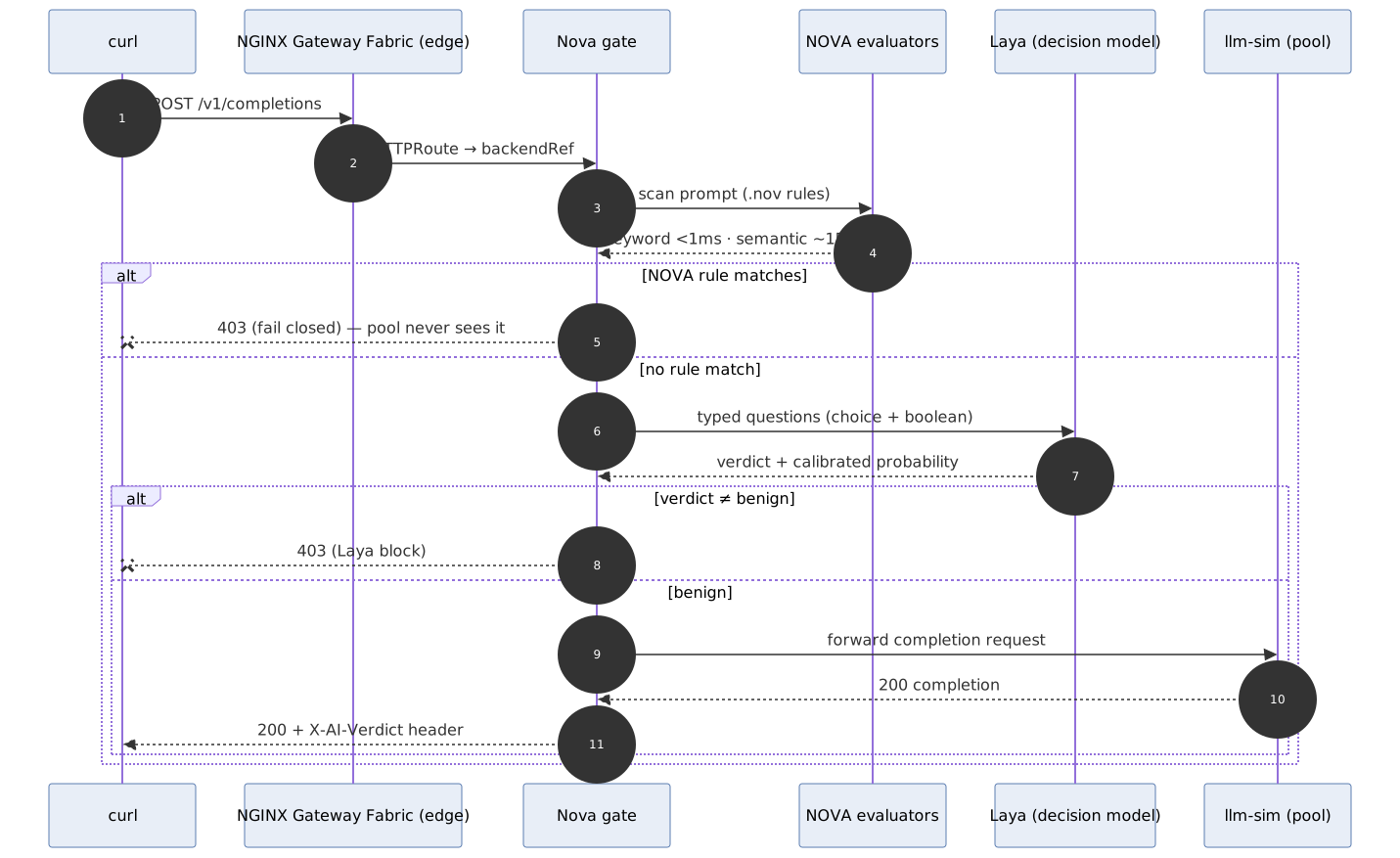
Figure 03 — Request lifecycle: NOVA’s evaluator tiers fire in escalating order (keywords <1 ms → semantics ~15 ms → LLM judge ~200 ms–2 s), then Laya’s classifier — fail-closed at every stage.
Planes mapping:
| Plane | Here | Classic network analogue |
|---|---|---|
| Management | .nov rules in Git; OpenTofu state; NOVA policy |
tmsh load sys config from-terminal; Terraform |
| Control | NOVA evaluators + Laya classifier computing verdicts | RIB computation; policy decision points |
| Data | NGINX Gateway Fabric enforcing 403/forward; Atlas answering | Line-card forwarding; WAF block pages |